
What Rivian’s AI Architecture Teaches Us About Enterprise Multi-Agent Software
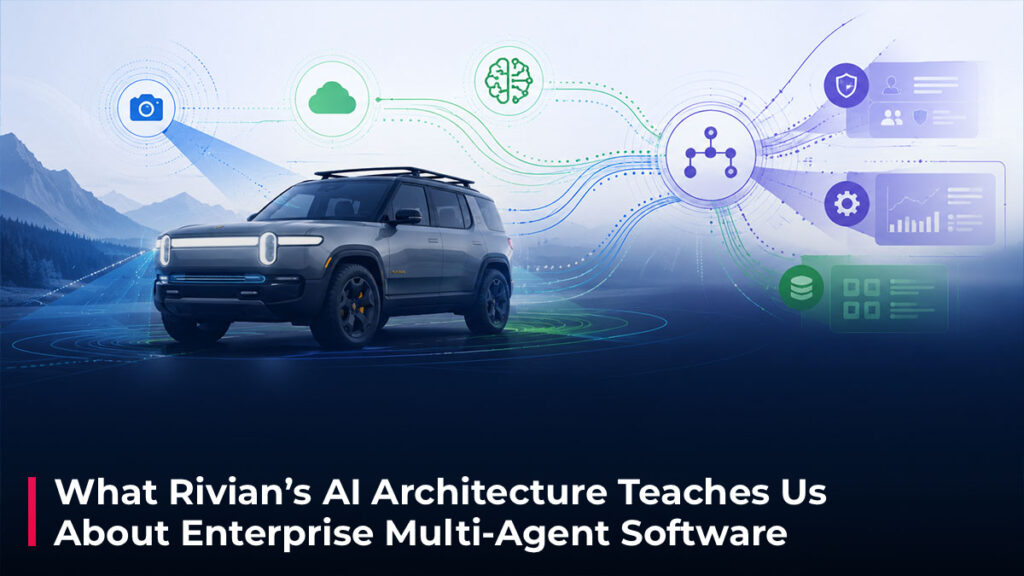
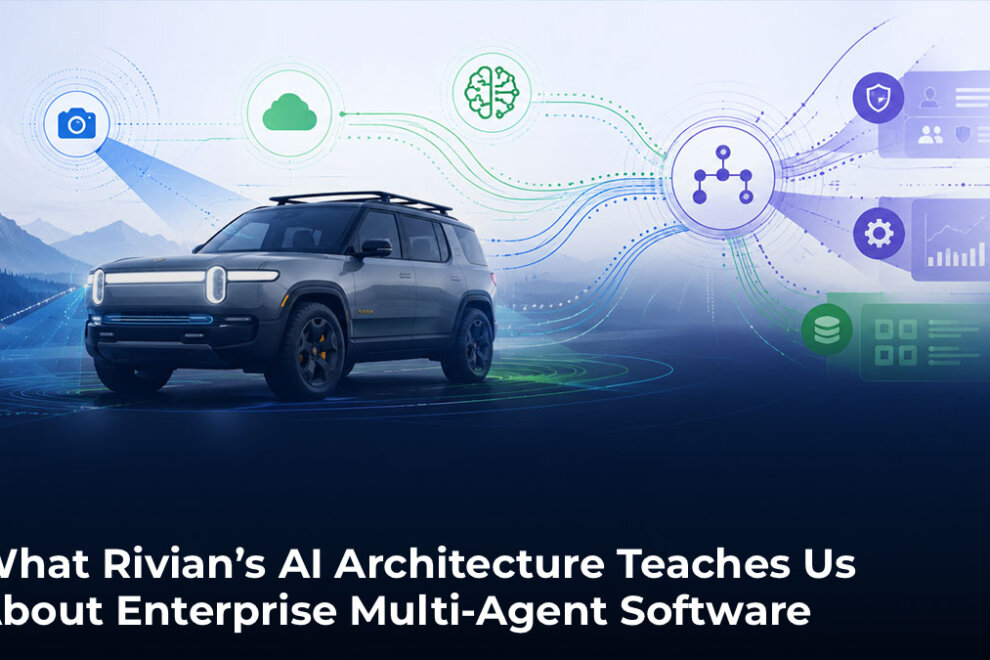
When most people look at Rivian, they see an electric vehicle manufacturer. From a software-development perspective, however, Rivian offers something else: a useful example of how AI models, physical hardware, cloud services, operational data, and third-party applications can work together as one connected system.
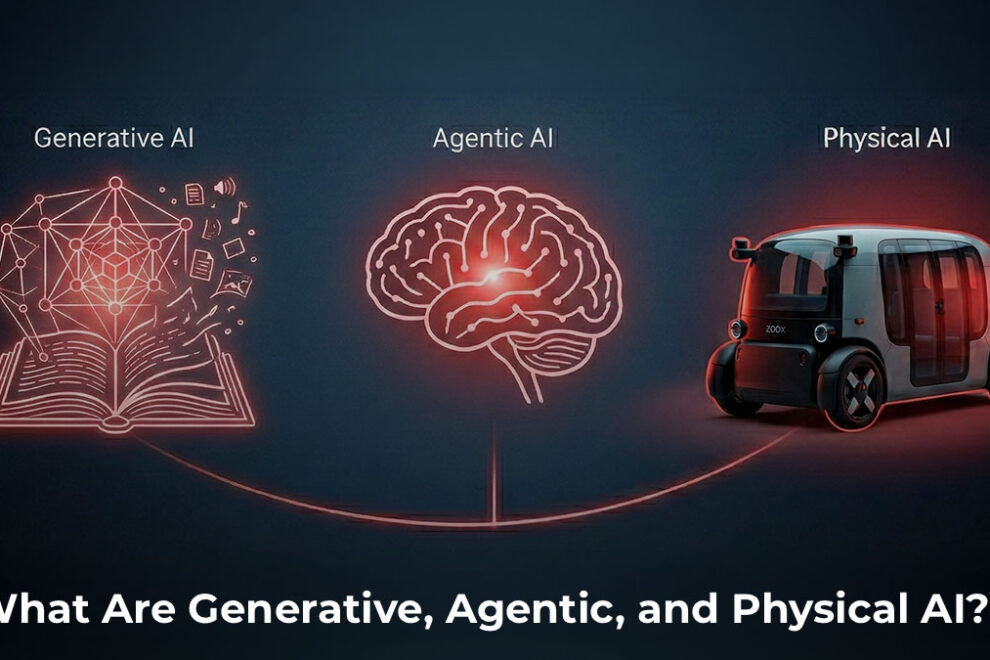
Rivian describes its direction as a transition from a software-defined vehicle to an AI-defined architecture. Its technology stack includes a generative driving model, an agentic in-vehicle assistant, a shared multimodal data foundation, custom processors, edge computing, and cloud-based improvement pipelines.
Rivian does not publicly describe this entire platform as a formal multi-agent system. It has, however, disclosed many of the same architectural patterns that enterprise multi-agent applications require:
- Shared context across multiple systems
- Specialized capabilities coordinated through an orchestration layer
- Access to internal controls and third-party services
- Deliberate use of both edge and cloud computing
- Continuous evaluation using real operational data
For enterprise development teams, the lesson is not that every organization should copy Rivian’s technology stack. It’s that valuable AI systems must connect intelligence to the data, tools, infrastructure, and controls required to perform real work.
Layer 1: Generative AI and the Continuous Improvement Loop

Traditional software works best when its rules can be clearly defined.
A payroll calculation, inventory threshold, or account-validation process can often be represented using deterministic logic. The same inputs should consistently produce the same results.
Other problems are less predictable. Driving is an extreme example. Construction workers use unfamiliar gestures, lanes suddenly merge, debris appears in the road, and other drivers behave inconsistently. Attempting to write a separate rule for every possible scenario quickly becomes impractical.
Rivian addresses this problem with its Large Driving Model, or LDM.
From Sensor Data to Driving Decisions
The LDM is an end-to-end model designed to learn relationships between the vehicle’s sensor data and the trajectory it should follow.
Rivian says the model uses an architecture similar in some respects to a large language model. A language model predicts an appropriate continuation of a sequence of words. Rivian’s driving model instead predicts an appropriate future path based on the vehicle’s surroundings.
The comparison is useful, but the two systems are not identical. A driving model must interpret spatial information, combine several sensor types, respond within strict time constraints, and operate in a safety-critical physical environment.
Rivian also applies reinforcement learning to identify driving strategies that balance factors such as safety, comfort, and appropriate road behavior. The resulting knowledge can then be transferred into models capable of operating within the vehicle’s available computing resources.
Building a Data Flywheel
The model’s value depends on the quality of the data behind it.
Supported Rivian vehicles can identify noteworthy or unusual driving events and send selected information to the Rivian Cloud. Rivian can then organize and label that data, use it to evaluate and improve its models, and deliver updated capabilities back to supported vehicles.
This produces a continuous improvement cycle:
- Vehicles encounter real-world conditions.
- Relevant events are identified and collected.
- Engineers and automated systems analyze model performance.
- Models, policies, or supporting software are improved.
- Updates are delivered back to the fleet.
The Enterprise Software Lesson
Businesses often assume an AI application must be nearly perfect before it can be released. In practice, complex systems improve when developers build a controlled process for capturing exceptions, measuring results, and correcting failures.
That does not mean an enterprise should automatically retrain a model every time something goes wrong.
Depending on the problem, the appropriate response may involve:
- Updating the system’s retrieved knowledge
- Improving prompts and instructions
- Changing which tools the system can use
- Adding validation rules
- Expanding automated evaluations
- Adjusting escalation thresholds
- Fine-tuning a model using reviewed data
The important architectural principle is not constant retraining. It’s the creation of an observable, governed improvement loop.
An enterprise AI system should tell developers where it failed, what information it used, which actions it attempted, and whether the final result was successful. Without that feedback, organizations may deploy AI but have no systematic way to make it better.
Layer 2: Agentic AI and the Orchestration Layer

Generative AI can interpret information and produce a response. Agentic AI goes further by using tools and taking actions to achieve a goal.
Rivian demonstrates this through Rivian Assistant and Rivian Unified Intelligence, or RUI.
Rivian describes RUI as a shared multimodal data foundation that supports vehicle features, service operations, diagnostics, and other parts of the business. Rivian Assistant uses this foundation, along with an in-house agentic framework, to connect natural-language requests with vehicle controls and external applications.
Moving Beyond Voice Commands
A traditional voice interface usually expects a specific command:
“Set the temperature to 70 degrees.”
An agentic interface can interpret a broader goal, determine which systems are needed, and coordinate several steps.
Rivian says its Assistant can interact with vehicle functions and third-party applications. Its first external agentic integration is Google Calendar. In one workflow, the Assistant can check a driver’s schedule, identify a destination, find a stop along the route, and send an updated arrival time to a contact.
From an architectural perspective, the important components are not necessarily separate autonomous agents with their own personalities. They are distinct capabilities coordinated through a shared layer:
- Vehicle controls
- Navigation
- Calendar access
- Messaging
- User context
- Location information
- Service and diagnostic data
RUI and Rivian Assistant provide the context and orchestration needed to determine which capabilities should be used and in what order.
What This Looks Like in an Enterprise
A similar enterprise workflow might begin with a customer asking:
“Where is my order, and can you update the delivery address?”
A basic chatbot may only retrieve the company’s shipping policy.
An agentic application could potentially:
- Verify the customer’s identity.
- Look up the order in an ERP or commerce platform.
- Check the package status through a shipping API.
- Determine whether the address can still be changed.
- Request human approval when required.
- Update the appropriate system.
- Confirm the result with the customer.
- Record the interaction in the CRM.
Behind that experience, the application may use specialized services or agents for identity verification, order management, logistics, policy checking, and customer communication.
The orchestration layer must maintain context, pass structured information between those capabilities, enforce permissions, and decide when a human needs to become involved.
When Multiple Agents Are Actually Useful
Not every integration needs to become an independent AI agent.
A deterministic API call is often safer and more efficient when a task has a predictable input and output. An agent becomes more useful when the system must interpret ambiguous information, select among several tools, plan multiple steps, or adapt when the original path fails.
Multi-agent architecture is most justified when specialized components need different data access, instructions, models, etc.
For example, a financial analysis agent may be allowed to review account data but not initiate a payment. A separate transaction service could execute the payment only after receiving structured authorization and human approval.
The goal is not to maximize the number of agents. It is to separate responsibilities where doing so improves security, reliability, maintainability, or performance.
Layer 3: Physical AI and the Infrastructure Stack

AI software is constrained by the infrastructure on which it operates.
Rivian’s architecture must process information from cameras and radar, run driving models with predictable response times, support vehicle controls, and continue performing critical functions when network connectivity is limited.
Its R2 platform uses 11 cameras and five radars as part of its perception system. Rivian also plans to introduce LiDAR on future R2 models to provide additional three-dimensional spatial data and sensing redundancy.
Purpose-Built Compute
Rivian developed the Rivian Autonomy Processor, or RAP1, specifically for its autonomy and neural-network workloads.
RAP1 supports multiple sensor types and is designed for inference with deterministic latency. Rivian’s Gen 3 Autonomy Computer reaches 1,600 sparse INT8 trillion operations per second, while RivLink allows multiple processors to communicate through a high-speed interconnect.
R2 also includes 200 sparse TOPS of edge AI computing power dedicated to the in-cabin experience. Rivian says this supports local execution of complex Assistant tasks, including some functionality when the vehicle is offline.
The Enterprise Edge-Cloud Decision
Most enterprise applications will not need custom silicon. They do, however, face the same fundamental architectural question:
Which workloads should run locally, and which should run in the cloud?
The answer should be based on the requirements of each task.
Local, on-premises, or edge processing may be preferable when an application requires:
- Very low latency
- Continued operation without an internet connection
- Strict data privacy
- Direct access to local equipment
- Predictable response times
- Reduced transmission of sensitive data
Cloud processing may be preferable when an application requires:
- Larger models
- Elastic computing capacity
- Centralized management
- Access from many locations
- Large-scale data processing
- Frequent model or service updates
Many enterprise AI systems should use a hybrid architecture.
A manufacturing agent might inspect equipment data locally so it can respond immediately to a potential failure. Aggregated performance data could then be sent to a cloud platform for long-term analysis, fleet-wide evaluation, and model improvement.
A healthcare application might process sensitive patient information inside a protected environment while using carefully controlled external services for non-sensitive workloads.
The correct architecture is not “cloud first” or “edge first.” Workloads should be placed according to latency, privacy, reliability, connectivity, security, and cost.
The Missing Layer: Governance and Human Control

Discussions of agentic AI often focus on what the system can do. Enterprise development teams must spend just as much time defining what it is allowed to do.
A multi-agent system that can access databases, update business applications, contact customers, or operate physical equipment creates new risks. Natural-language reasoning alone should not be the final control protecting a consequential business process.
Every agent or capability should have clearly defined boundaries.
Permission Controls
Each component should receive only the minimum access needed to perform its function.
A customer-service agent may be able to read order information but should not automatically receive permission to issue an unlimited refund. A maintenance agent may recommend that a machine be shut down, while a separate safety system validates and executes the action.
Human Approval
High-impact decisions may require a person to review the proposed action.
Human approval is especially appropriate for:
- Financial transactions
- Contract changes
- Sensitive customer communications
- Healthcare decisions
- Employment actions
- Destructive system operations
- Physical safety controls
The goal is not maximum autonomy. It is the appropriate level of autonomy for the risk involved.
Deterministic Guardrails
Some requirements should remain conventional software rules.
An AI model may recommend a refund, but deterministic logic can ensure the amount does not exceed an approved limit. An agent may create a database query, but a validation layer can prevent it from modifying restricted tables.
AI reasoning and deterministic software should complement one another.
Observability and Auditability
Developers need visibility into:
- The user’s request
- The context supplied to the model
- The tools or agents selected
- The data each component accessed
- The actions attempted
- Errors and retries
- Human approvals
- The final outcome
Without this information, it becomes difficult to investigate failures, evaluate performance, or demonstrate compliance.
Security Against Malicious Instructions
Agentic systems may encounter untrusted content in emails, documents, websites, support tickets, and connected applications.
That content can contain instructions designed to manipulate the AI into revealing information or taking unauthorized actions. Secure architectures must separate trusted system instructions from untrusted data, validate tool calls, restrict permissions, and treat retrieved content as information rather than authority.
The Real Enterprise Lesson
Rivian’s architecture is compelling because intelligence is not isolated inside a chatbot.
Its models connect to sensors, vehicle controls, operational information, cloud infrastructure, external services, and continuous improvement systems. The hardware and software are designed to support one another.
Enterprise AI should be approached in the same way.
A useful AI system is rarely just a model connected to a chat window. It is a complete software architecture that must understand the user’s goal, protect sensitive data, measure whether the result was successful, and request approval when necessary.
This does not mean every organization needs an elaborate multi-agent platform. A focused assistant connected to a reliable knowledge base may be the right solution for many problems.
Multi-agent architecture becomes valuable when a workflow crosses several systems, requires different types of reasoning, or needs specialized components with separate permissions and responsibilities.
From our perspective as software developers, the main takeaway from Rivian is not that autonomous agents will replace conventional software. It is that AI becomes significantly more useful when it is engineered as part of a broader system.
Models provide interpretation and reasoning. APIs provide access to business systems. Deterministic code provides reliability. Infrastructure provides performance and availability. Governance provides control.
The strongest enterprise AI applications combine all of them.
Rivian is applying those principles to vehicles operating in the physical world. The same architectural thinking can help businesses build AI systems capable of navigating complex workflows, provided the technology is designed around a real operational need rather than around AI for its own sake.