

The Complete Guide to Mobile Game Development in 2026
Today, mobile gaming has become a billion-dollar ecosystem. In 2025 alone, it generated over $108 billion, outperforming the combined revenues of console and PC gaming. And the momentum isn’t fading anytime soon.
However, here’s an uncomfortable truth: most game concepts never make it past the prototype stage. Even those that launch often disappear within weeks.
The games dominating the charts right now didn’t get there by luck. They made deliberate execution choices, including choosing the right engine, planning monetization early, and building for the constraints of mobile hardware from day one.
In this guide, we are covering the full mobile game development process, from picking the right engine and platform to setting up monetization and managing LiveOps after launch. It walks you through the key decisions that impact performance, user experience, and long-term growth.
Table of Contents
- What is Mobile Game Development?
- How Mobile Games Are Developed?
- Mobile Game Development Engines and Tools
- Mobile Game App Development Platforms
- Types of Mobile Game Development Services
- Mobile Game Development Technologies
- Mobile Game Monetization Strategies
- How To Launch And Grow A Mobile Game
- LiveOps and Post-Launch Mobile Game Support
- How to Choose A Mobile Game Development Company
- How Much Does Mobile Game Development Cost
- Mobile Gaming Solutions for Every Vision
- FAQs About Mobile Game Development
What is Mobile Game Development?
Mobile game development is the process of building interactive games for iOS and Android devices using engines like Unity, Unreal, CryEngine or Godot. It combines multiple disciplines, including engineering, art creation, animation, sound design, fun game design, and monetization design.
Building games in 2026 sounds like an opportunity until you realize the phones for which you are building range from flagship models to budget devices from 2019, and your game needs to work smoothly on all of them while competing with 50 other games launching the same day.
Here’s what makes mobile game development different from everything else:
- Touch is your only input: No controllers, no keyboard, no mouse. Just fingers on glass.
- Sessions are short: People play mobile games in 5-10 minute bursts between other activities. Your core gameplay loop should be satisfying.
- Performance is crucial: Your game runs on different platforms and devices, all the way sharing device resources with every other app. Your game needs to run smoothly without destroying battery life or overheating the phone.
The cost of developing a mobile game can range from around $20,000 for a simple casual title to $300,000 or more for feature-rich games with multiplayer functionality. However, budget alone doesn’t determine success. Winning titles prioritize fast iteration cycles, optimize for mobile hardware limitations, and design monetization systems early.
In short, mobile game development is about creating entertainment that respects people’s time and device constraints while still being engaging enough to come back to daily. That balance is what separates hits from forgotten downloads.
How Mobile Games Are Developed?
Most successful studios use a Game Design Document (GDD) to align the team on vision, mechanics, and scope before writing any code. Starting with a Minimal Viable Product (MVP) lets you test core gameplay early, then iterate based on real feedback.
1. Discovery and Requirements Gathering
This phase defines what you’re building and why. Teams identify the target audience, core gameplay concept, business goals, and primary platforms for release. You’ll also establish success metrics and competitive positioning here.
2. Pre-Production and Prototyping
Pre-production is where ideas turn into executable plans. The team creates the GDD, wireframes, and a playable prototype centered around the core loop, the fundamental action players repeat throughout the game. In Candy Crush, for example, the core loop is matching candies to clear levels and unlock rewards.
3. Game Design and UI/UX
Game design defines how the game feels, functions, and keeps players engaged over time. It includes crafting core mechanics, structuring levels, designing balanced difficulty curves, and building progression systems that reward players at the right pace. Every element must support the core loop and create a sense of challenge, achievement, and momentum.

UI/UX design ensures players can navigate menus and interact with the game intuitively on touchscreens. On mobile, this requires thoughtful adaptation to touchscreen interactions, thumb-friendly button placement, shorter session lengths, and readable texts across varying screen sizes.
4. Art and Asset Production
This stage produces all visual and audio content: character designs, environments, animations, sound effects, and music. And the challenging part here is about balancing visual fidelity with mobile performance, as heavy textures and advanced particle effects can strain mobile GPUs, impact battery efficiency, and reduce frame stability.
5. Development and Engineering
Engineering brings everything together. Developers code gameplay systems, integrate art assets, build backend infrastructure, and connect third-party APIs for analytics and monetization.
- C# with Unity: The most popular choice, offering a balance of performance and development speed
- C++ with Unreal: Preferred for graphically intensive titles requiring maximum performance
- Visual scripting (Blueprints): Allows designers to create gameplay logic without writing code.
6. Quality Assurance and Testing
Ever wonder why some games crash constantly while others just work? Device testing. Your game might run beautifully in Unity’s simulator and on your personal iPhone, then completely fail on a two-year-old Android phone with a slightly different processor.
Testing on real devices across brands, OS versions, and price points helps catch these disasters before launch. Many studios also run closed beta tests with real players before launch.
7. Deployment and App Store Submission
Preparing for launch involves creating store listings, screenshots, preview videos, and metadata optimized for discoverability. Both Apple’s App Store and Google Play have specific requirements and review processes that can take anywhere from a few hours to several days.
Mobile Game Development Engines and Tools
Your choice of game engine shapes the entire development process. Each engine has strengths suited to different project types and team sizes. Let’s break down the major players:
| Engine | Best For | Primary Language | 2D/3D Support |
|---|---|---|---|
| Unity 3D | Most mobile games | C# | Both |
| Unreal Engine | High-fidelity 3D | C++/Blueprints | Primarily 3D |
| CryEngine | Immersive environments | C++/Lua | Primarily 3D |
| HTML5/WebGL | Browser-based casual games | JavaScript | Primarily 2D |
Unity 3D
Unity dominates mobile game development, powering titles like Subway Surfers, Monument Valley, and Pokémon GO. Its extensive asset store, cross-platform deployment, and active community make it accessible for teams of all sizes. The engine handles both 2D and 3D projects well.
Unreal Engine
Unreal excels at visually ambitious projects where graphical fidelity matters. Its Blueprint visual scripting system lets designers prototype without coding, while C++ access provides the performance for demanding games. The trade-off is a steeper learning curve and larger build sizes compared to Unity.
CryEngine
CryEngine offers powerful rendering capabilities for realistic environments and complex visual effects. It’s less common in mobile development, but can be the right choice for projects pushing graphical boundaries.
HTML5 and WebGL Frameworks
Browser-based development using HTML5 and WebGL frameworks like Phaser or PixiJS allows games to run without app store downloads. This approach works well for casual, 2D experiences where reducing friction to play matters more than advanced features.
Mobile Game App Development Platforms
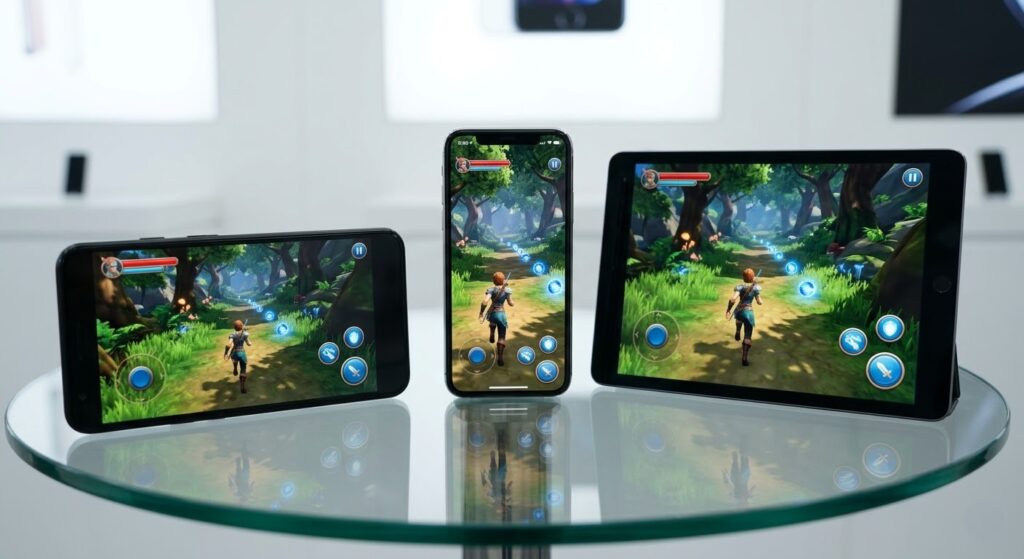
Platform choice affects your potential audience, development approach, ongoing maintenance and revenue model . Each path involves trade-offs between reach, performance, and efficiency.
iOS Game Development
iOS app development is primarily built using Swift or Objective-C, with apps developed and tested within Apple’s Xcode environment. The iOS user base tends to spend more on apps and in-app purchases, making it attractive for premium and freemium games. Apple’s review process is thorough, sometimes taking several days.
Android Game Development
Android game development typically uses Kotlin or Java with Android Studio. The platform offers broader global reach, particularly in emerging markets, but device fragmentation creates testing challenges. Thousands of Android device configurations exist with varying screen sizes, processors, and OS versions.
Cross-Platform Mobile Game Development
Cross-platform app development using engines like Unity lets you build once and deploy to multiple platforms. This approach reduces development time and maintenance overhead but may sacrifice some platform-specific optimizations. For most mobile games, Unity’s cross-platform capabilities provide the best balance of efficiency and performance.
Types of Mobile Game Development Services
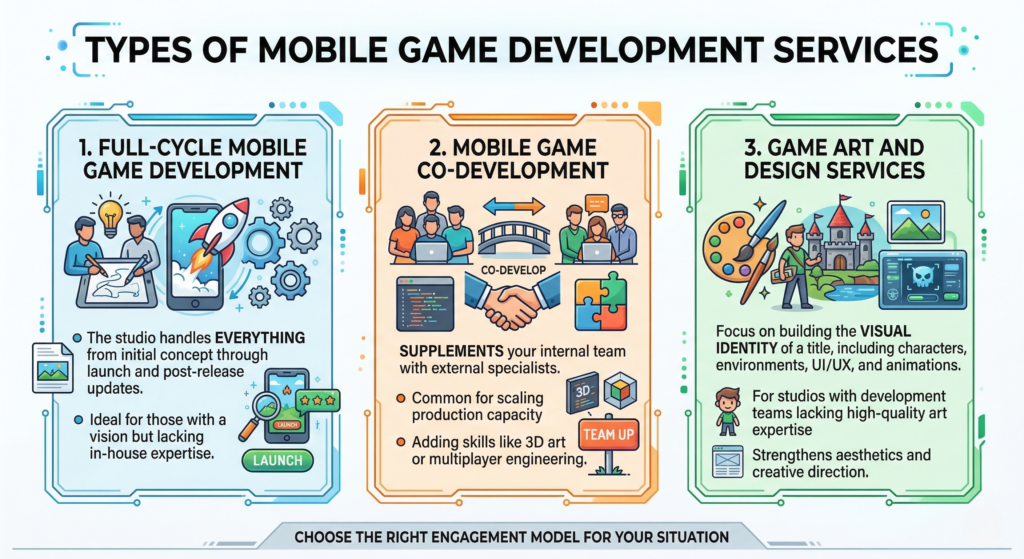
When working with a game development company, understanding the available engagement models helps you choose the right fit for your situation.
Full-Cycle Mobile Game Development
Full-cycle development means the studio handles everything from initial concept through launch and post-release updates. This approach works well when you have a vision but lack in-house game development expertise.
Mobile Game Co-Development
Co-development partnerships supplement your internal team with external specialists. This model is common when scaling production capacity or adding skills like 3D art or multiplayer engineering.
Game Art and Design Services
Game art services focus on building the visual identity of a title, including characters, environments, UI/UX elements, and animations. Studios with robust development teams may not have the internal bandwidth or expertise for high-quality art production. They often collaborate with specialized art partners to strengthen aesthetics and creative direction without overextending internal resources.
Mobile Game Development Technologies
The mobile game development stack spans programming languages, powerful cross-platform engines, scalable backend infrastructure, and monetization tools to support performance and long-term growth.
- Core Programming Languages: C#, C++, Java, Kotlin, JavaScript
- Cross-Platform Frameworks: Platforms like Unity and Unreal Engine dominate high-performance game creation, while frameworks such as React Native and Flutter enable hybrid or companion app development.
- Backend and Cloud Services: Amazon Web Services, Firebase, and PlayFab to handle multiplayer scaling, real-time data sync, and LiveOps support.
- Analytics and Monetization SDKs: SDKs like Unity Ads, Google AdMob, ironSource enable in-app advertising, player analytics, and revenue optimization.
Mobile Game Monetization Strategies
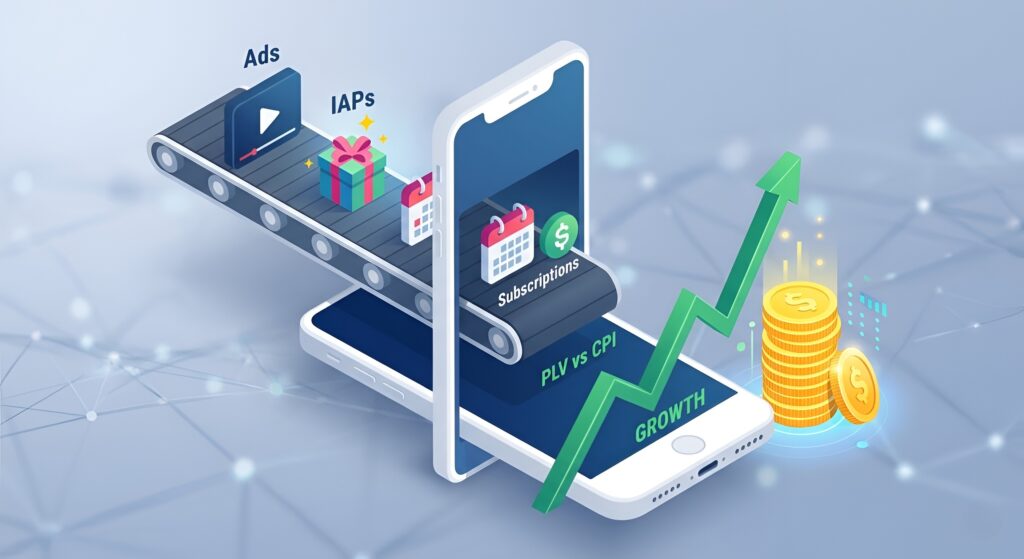 Monetization should never be an afterthought. The monetization model you choose directly influences gameplay mechanics, progression systems, economy design, and even retention strategy, which is why it must be defined during pre-production, not just before launch.
In-App Purchases
In-app purchases (IAPs) let players buy virtual currency, power-ups or items using real money. Clash of Clans gem purchases and Fortnite’s V-Bucks are well-known title examples. The key to successful IAP design is balance that offers meaningful value without creating a “pay-to-win” environment that alienates non-paying players.
In-App Advertising
Ad integration through tools like Unity Ads or Google AdMob generates revenue from players who don’t make purchases.
- Rewarded Video Ads: Players voluntarily watch ads in exchange for in-game rewards.
- Interstitial Ads: Full-screen ads shown between gameplay sessions
- Banner Ads: Persistent ads displayed during gameplay
Among these, rewarded video typically offers the best balance between revenue generation and player experience.
Premium and Paid Downloads
The upfront purchase model charges players before they install. While less common now, it remains viable for certain game types, particularly narrative-driven or puzzle games where the complete experience is delivered without ongoing monetization mechanics.
Subscription Models
Subscription-based models provide ongoing content access for recurring payments. Apple Arcade titles use this approach, offering ad-free experiences with regularly updated content.
How to Launch And Grow A Mobile Game
Development is only half the challenge. Getting players to discover, download, and keep playing your game requires deliberate effort.
App Store Optimization for Mobile Games
App Store Optimization (ASO) improves your game’s visibility within app store search results. It directly impacts organic downloads.
Effective ASO includes:
- Strategic keyword placement in title and description,
- High-converting visual assets (icons, screenshots, preview videos) that communicate gameplay quickly,
- Strong ratings and reviews that influence download decisions.
User Acquisition Strategies
Paid advertising through app marketing platforms like Facebook, Google, and TikTok drives downloads but requires careful tracking of Cost per Install (CPI) versus Player Lifetime Value (PLV).
Additional acquisition strategies include:
- Influencer marketing
- Cross-promotion with other games
- Soft launches in select markets to test retention and optimize before a global release.
Player Retention and Engagement
Acquiring players costs money; keeping them costs less.
Keeping players engaged requires thoughtful design decisions, such as:
- Daily login rewards
- Time-limited events
- Push notifications tied to meaningful in-game activity
- Social features like guilds, clans, or leaderboards
- Data-driven adjustments to difficulty curves and progression pacing
LiveOps and Post-Launch Mobile Game Support
The most successful mobile games maintain active development long after launch.
LiveOps includes:
- Content updates
- Seasonal or limited-time events
- Balance updates,
- Bug fixes
- Server maintenance and scalability planning
- Community management.
Games like Clash Royale and Genshin Impact demonstrate how ongoing LiveOps investment keeps players engaged for years.
How to Choose A Mobile Game Development Company
Selecting the right development partner significantly impacts project success.
- Portfolio and Industry Experience: Review past projects for games similar to your vision in genre, scope, and quality. Client references and case studies reveal how the studio handles challenges and communicates throughout development.
- Technology and Engine Expertise: Match the studio’s engine expertise to your project requirements. A team with deep Unity experience may not be the right fit for an Unreal-based project.
- Development Process Transparency: Clear communication, milestone reviews, and agile practices provide visibility into progress. Ask about their project management approach and what deliverables you’ll receive at each stage.
- Post-Launch Support Capabilities: Evaluate whether the partner offers ongoing maintenance, LiveOps, and update services. A studio that only handles initial development may not be the right choice if you’re planning a games-as-a-service model.
How Much Does Mobile Game Development Cost
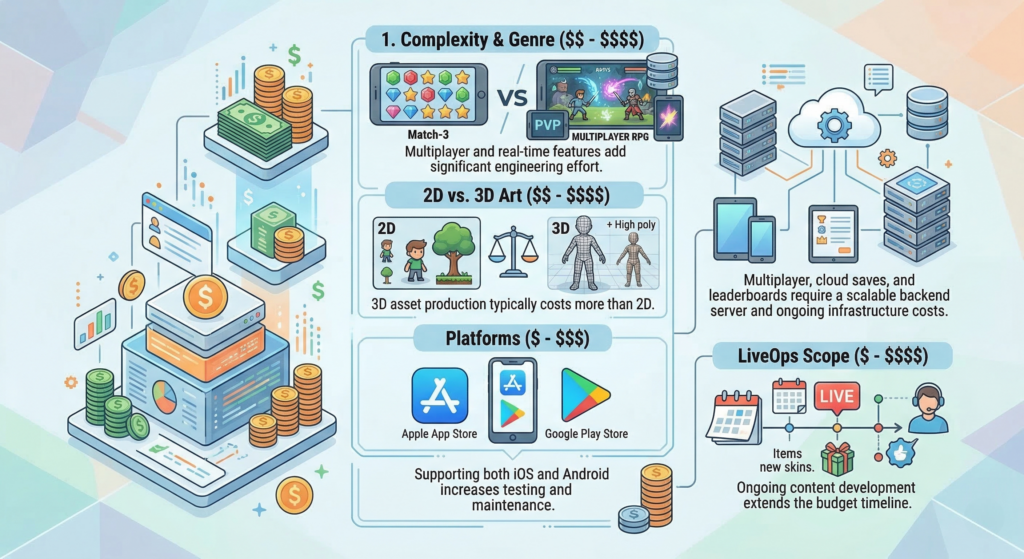
Costs vary widely based on complexity, art quality, platforms, and features. Simple casual games might cost $20,000–$50,000, while complex titles with multiplayer and 3D graphics can exceed $300,000.
Here’s what actually drives cost:
- Game Complexity and Genre: Multiplayer and real-time features add significant engineering effort.
- 2D vs. 3D Art Requirements: 3D asset production typically costs more than 2D.
- Single Platform vs. Cross-Platform: Supporting both iOS and Android increases testing and maintenance.
- Backend Infrastructure: Multiplayer, cloud saves, and leaderboards require a scalable backend server and ongoing infrastructure costs.
- LiveOps Scope: Ongoing content development extends the budget timeline.
Mobile Gaming Solutions for Every Vision
Great mobile games need three things working together: creative vision that resonates with players, technical execution that brings that vision to life reliably, and strategic operations that keep the game thriving post-launch.
Zco’s been doing this long enough to know where projects usually break down and how to prevent it. We work across Unity 3D, Unreal Engine, and CryEngine depending on what your game needs. Our art teams are embedded in the process, not siloed. We’ve got AR/VR expertise for when standard mobile isn’t enough. And we treat LiveOps as essential, not optional.
If you’re ready to transform your game concept into a scalable, launch-ready product, let’s talk.
Connect with us to explore your mobile game development roadmap.
FAQs About Mobile Game Development
How long does it take to develop a mobile game from concept to launch?
Timeline depends on game complexity, team size, and scope. Simple casual games might take three to six months, while complex titles with multiplayer features can take a year or more. Soft launch periods for testing add additional time before global release.
What is the difference between native and cross-platform mobile game development?
Native development builds separately for iOS and Android using platform-specific tools like Swift/Xcode and Kotlin/Android Studio. Cross-platform development uses engines like Unity to deploy a single codebase to multiple platforms. Most mobile games use cross-platform engines because the performance trade-offs are minimal while efficiency gains are significant.
Can a mobile game be updated after it launches on app stores?
Yes, most successful mobile games release regular updates with new content, bug fixes, balance changes, and seasonal events through the app store update process. Both Apple and Google review updates, though the process is typically faster than initial submission.
Who owns the source code when working with a mobile game development company?
Ownership terms vary by contract. Some studios retain ownership and license the code to clients, while others transfer full ownership upon project completion. Clarify intellectual property rights and source code access before signing any development agreement.
Which mobile game genres are most popular with players?
Casual games, puzzle games, action/adventure, and simulation titles consistently perform well in download numbers and revenue. However, success depends more on execution and market fit than genre alone.
