

What Are Generative, Agentic, and Physical AI?
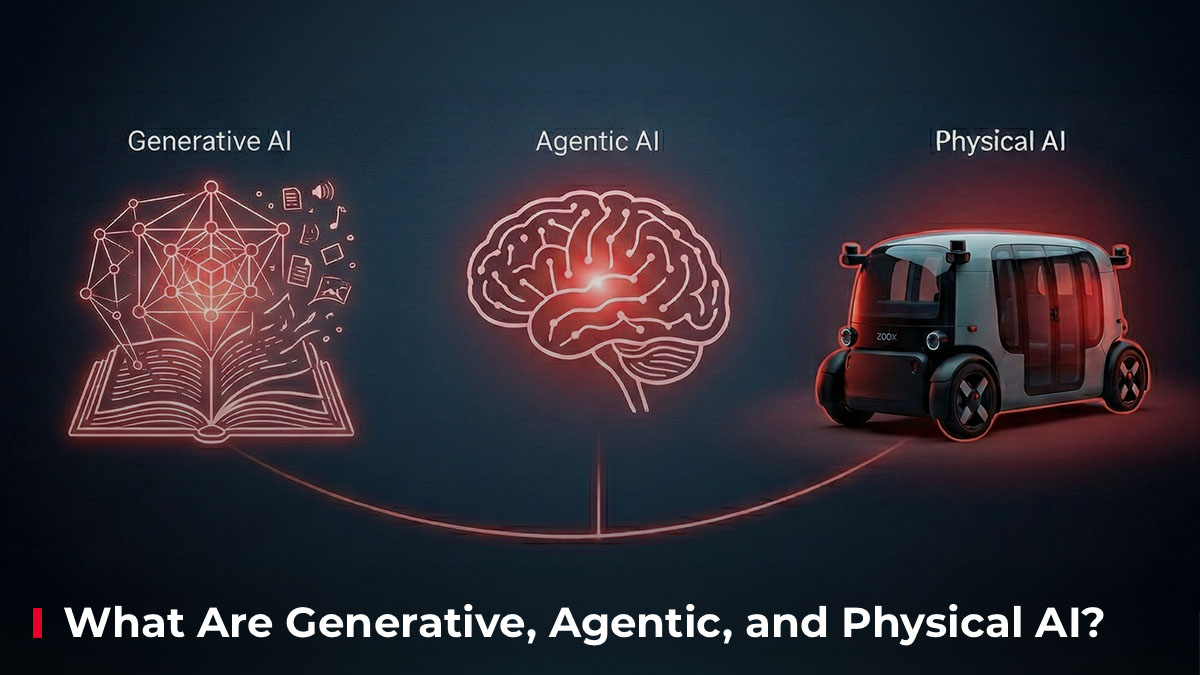
Generative AI creates new content. Agentic AI takes action toward goals. Physical AI acts in the real world through machines.
Artificial intelligence is no longer a single category of technology. It has evolved into distinct capabilities that are beginning to reshape how organizations operate, innovate, and compete. Three terms now define the frontier: generative AI, agentic AI, and physical AI.
Understanding the differences between them, and how they build on each other, is essential for making informed strategic decisions. Each represents a different layer of capability, from producing ideas to executing workflows to interacting with the physical world.
Below is a clear breakdown of what each type of AI is, how it works, and where it creates measurable business value.

Generative AI: Creating Content and Insight at Scale
Definition: Generative AI produces new content like text, images, code, video, audio, or structured outputs based on patterns it has learned from existing data.
Generative AI systems are trained on large datasets. Instead of retrieving answers from a database, they generate responses statistically, predicting what comes next in a sequence. The result feels intelligent because it reflects learned language structures, styles, and domain knowledge.
Common examples include:
Large language models that draft reports or answer questions
AI systems that generate images or design concepts
Code-generation tools that accelerate software development
AI copilots that assist with research and documentation
The public breakthrough moment came with tools like ChatGPT, which demonstrated how natural and useful AI-generated text could be. But the real opportunity lies beyond novelty.
Where Generative AI Creates Value
Generative AI excels at increasing knowledge productivity:
Drafting proposals, summaries, and technical documentation
Automating customer support responses
Generating personalized marketing content
Accelerating product design iterations
Assisting engineers with code and debugging
For organizations, generative AI reduces time spent on repetitive intellectual tasks. It improves speed to market, lowers content production costs, and unlocks new levels of personalization at scale.
However, generative AI is primarily advisory and creative. It produces outputs, but it does not independently make decisions or take action beyond the prompt it is given.

Agentic AI: Taking Action Toward Defined Goals
Definition: Agentic AI systems can plan, make decisions, and execute multi-step tasks autonomously in pursuit of a goal.
If generative AI is about producing content, agentic AI is about completing outcomes.
An AI agent is given an objective, access to tools or systems, and the ability to reason through steps. It can:
• Break down a goal into subtasks
• Determine what actions to take
• Use APIs, databases, or software systems
• Adjust its approach based on feedback
• Continue until the task is complete
Unlike a simple chatbot, agentic AI systems can operate across multiple applications like CRM platforms, ERP systems, data warehouses, scheduling tools, and more.
What Makes Agentic AI Different?
The difference lies in autonomy and persistence.
A generative AI model waits for prompts. An agentic system can initiate actions within defined guardrails. It doesn’t just answer, “What should we do?” It begins doing it.
Examples of agentic use cases include:
• Automatically qualifying inbound leads and scheduling sales meetings
• Monitoring supply chain data and reordering inventory
• Coordinating onboarding workflows across departments
• Conducting financial reconciliations
• Managing cloud infrastructure optimization
In these cases, AI moves from advisory support to operational execution.
Strategic Implications
Agentic AI changes cost structures and capacity models.
Instead of hiring incremental staff for each new operational burden, organizations can deploy AI agents to handle structured, repeatable workflows. Human teams shift toward oversight, exception handling, and higher-value strategic work.
This is where productivity improvements compound. Generative AI saves time per task. Agentic AI reduces the number of tasks requiring human intervention at all.
Still, both operate primarily in digital environments.
The next frontier moves beyond screens.
Physical AI: Intelligence in the Real World
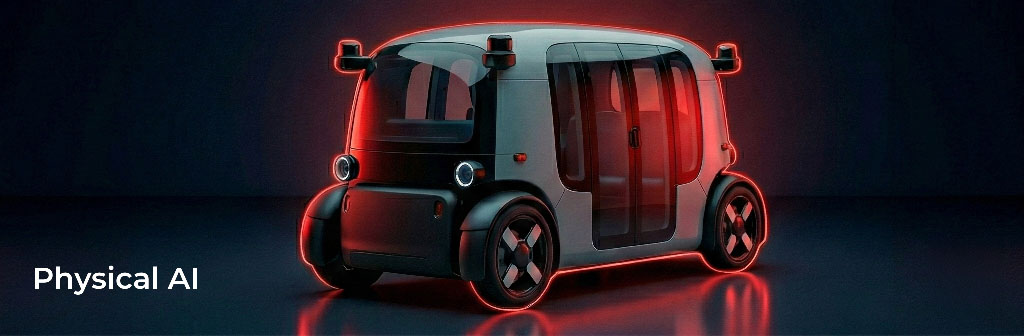
Definition: Physical AI combines artificial intelligence with robotics, sensors, and hardware systems to perform tasks in the real world.
If generative AI creates ideas and agentic AI executes digital workflows, physical AI moves atoms.
This category includes:
• Autonomous warehouse robots
• Self-driving vehicles
• Robotic manufacturing systems
• Intelligent drones
• AI-powered medical robotics
Physical AI systems integrate perception (via cameras, LiDAR, and sensors), reasoning (via AI models), and mechanical action (via motors and robotic components).
Companies like Tesla, Rivian and Boston Dynamics illustrate how AI is increasingly embedded into machines that interact with dynamic environments.
What Makes Physical AI Complex?
Physical AI operates in unpredictable conditions. Unlike digital systems, the physical world is messy:
• Lighting changes
• Objects move unpredictably
• Sensors produce imperfect data
• Safety constraints are critical
As a result, physical AI requires more robust testing, simulation, and fail-safe mechanisms than purely digital AI systems.
Where It Delivers Value
Physical AI is transforming sectors such as:
• Manufacturing and logistics
• Agriculture
• Transportation
• Construction
• Healthcare
The value often lies in:
• Reducing labor shortages
• Improving safety
• Increasing precision
• Operating continuously without fatigue
• Collecting real-time operational data
Physical AI tends to require higher upfront investment, but the scale benefits can be significant in capital-intensive industries.
How These Three AI Categories Relate to Each Other
These technologies are not isolated. They form a progression of capability:
• Generative AI creates content and recommendations.
• Agentic AI turns recommendations into action within digital systems.
• Physical AI extends action into the real world.
They also increasingly intersect.
For example:
• A generative model drafts maintenance recommendations.
• An AI agent schedules technicians and orders replacement parts.
• A robotic system executes the physical repair or inspection.
Together, they form an integrated, AI-driven operating system for an enterprise.
What This Means for Organizations
The immediate opportunity is not to pursue all three at once. It is to align AI capabilities with business constraints and growth priorities.
1. Start Where Friction Is Highest
Look for:
• Repetitive knowledge work (generative AI opportunity)
• High-volume operational workflows (agentic AI opportunity)
• Labor-intensive or hazardous physical processes (physical AI opportunity)
The right entry point depends on industry and current digital maturity.
2. Treat AI as Infrastructure, Not a Feature
Adopting AI piecemeal creates isolated wins but limited transformation.
Forward-looking organizations build:
• Clean data pipelines
• API-accessible systems
• Secure governance frameworks
• Clear human oversight models
AI amplifies what already exists. Weak processes become automated inefficiencies. Strong systems become scalable advantages.
3. Balance Autonomy with Control
As AI systems gain autonomy, oversight becomes critical. That includes:
• Defined decision boundaries
• Transparent logging and auditing
• Clear escalation protocols
• Ongoing model monitoring
The goal is not to eliminate human judgment, but to elevate it.
The Competitive Landscape Is Shifting
The rise of generative AI lowered the barrier to entry for intelligence-driven tools. Agentic AI is lowering the marginal cost of operations. Physical AI will reduce constraints tied to labor and geography.
Organizations that understand these layers can:
• Improve speed of execution
• Expand capacity without proportional hiring
• Deliver higher personalization
• Increase operational resilience
Those that treat AI as a tactical add-on may see incremental gains. Those that integrate it strategically may redefine their cost structure and service model.
A Clear Framework Moving Forward
To navigate the AI landscape, consider three questions:
What decisions consume the most human time?
Explore generative AI to augment thinking and production.
What workflows are rule-driven and repetitive?
Explore agentic AI to automate execution.
What physical processes are constrained by labor, precision, or safety?
Explore physical AI solutions that combine robotics and intelligence.
Not every organization needs robotics today. Nearly all can benefit from generative or agentic systems in the near term.
Final Perspective
Generative, agentic, and physical AI represent different levels of capability, not competing trends.
Generative AI enhances human creativity and knowledge output.
Agentic AI amplifies operational execution.
Physical AI extends intelligence into machines interacting with the real world.
Together, they signal a shift from software that informs, to software that acts.
The question is no longer whether AI will impact your organization. It is which layer of intelligence will create the greatest strategic leverage and how quickly you can deploy it responsibly.
The organizations that win will not simply use AI tools. They will redesign how work gets done.
Ready to Turn AI Strategy Into Execution?
Whether you’re exploring generative AI, building multi-agent systems, or integrating AI into physical workflows, Zco helps mid-market organizations design and deploy secure, scalable solutions. Let’s identify where AI will create measurable operational advantage for your business. Explore how Zco helps businesses build scalable, real-world AI solutions with our AI development services.
